Automation Is Over. Agents Are Here: What Wade Foster Sees Coming Next
Before AI agents became the biggest conversation in tech, Wade Foster was already building the infrastructure that would make them useful.
As co-founder and CEO of Zapier, Wade helped pioneer a simple but powerful idea: Non-technical people should be able to connect software and automate work, without writing code.
Since launching in 2011, Zapier has quietly become the connective tissue of the modern business stack — integrating with 8,000+ applications across nearly every category of software.
For years, that looked like automation. Now, it looks like something much bigger.
Because as AI agents emerge as the new interface to software…
Zapier isn’t just connecting tools.
It’s becoming the action layer behind AI.
And that puts Wade at the center of one of the most important shifts happening right now. Listen to our conversation with Wade to understand what’s coming next — and what it means for how your team will operate.
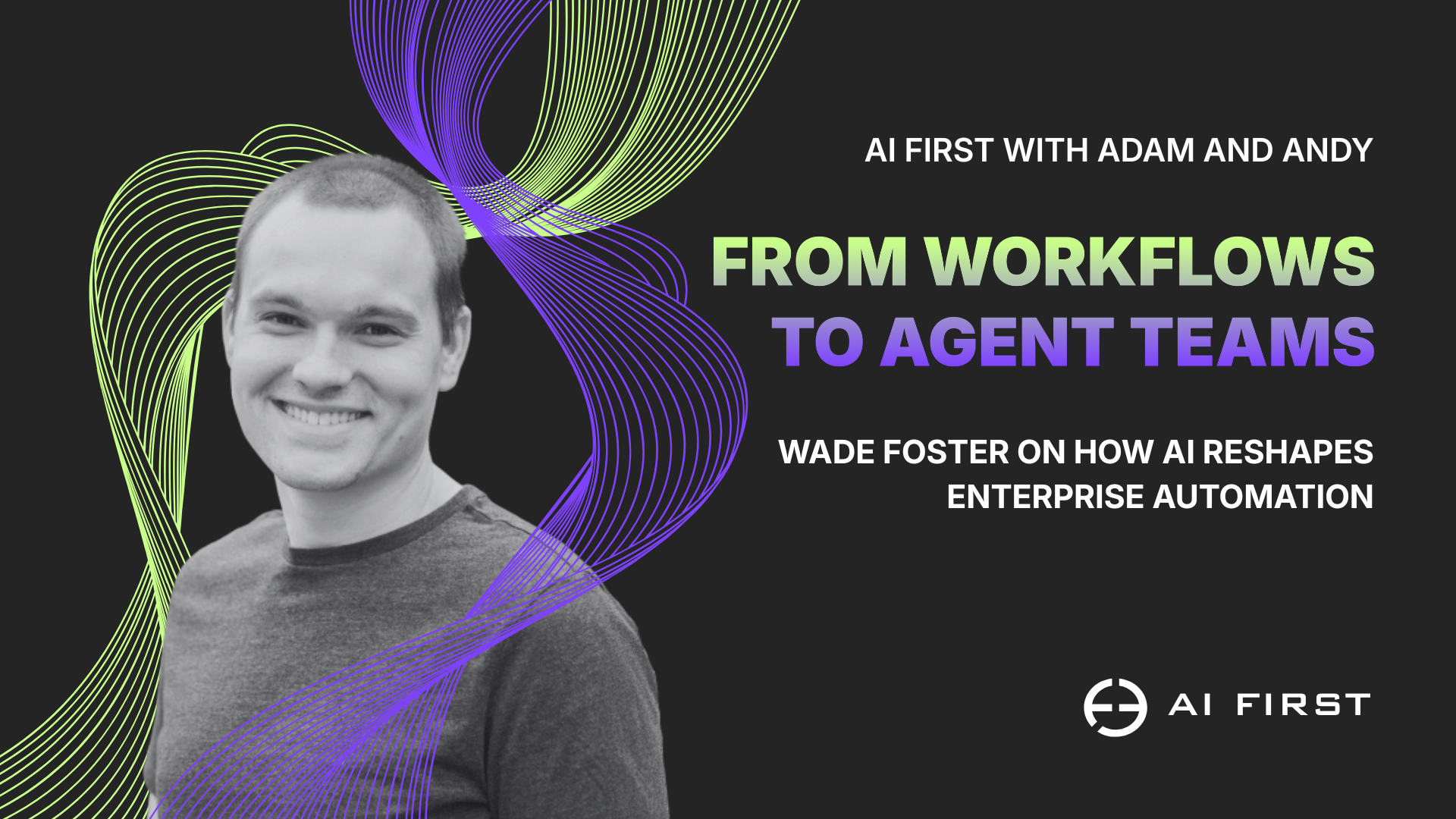
The Hidden Advantage: 8,000 Connections
Zapier’s decade-long investment in integrations is no longer just a feature.
It’s a moat.
Because in a world of AI agents, capability isn’t about intelligence alone — it’s about action.
What can the agent actually do?
The fact that we are connected into over 8,000 different tools is a huge asset… any company that thinks AI won’t impact them is making a foolish choice.
This is the unlock: AI is becoming the interface. Connectivity is what makes it useful.
Without it, agents can think — but they can’t act.
The Future Org Chart: One Human, Many Agents
This is where it gets real.
Wade Foster’s model for the future isn’t incremental — it’s structural:
One domain expert, paired with a team of AI agents.
Not departments.
Not layers.
Just focused operators with leverage.
We’re already seeing this in engineering. Developers aren’t writing every line of code anymore — they’re designing systems, directing agents, and reviewing outputs. That same shift is now spreading into marketing, operations, finance, and beyond.
Work is moving up the abstraction layer.
Humans define the problem.
Agents execute the tasks.
And this shift is already changing how companies hire.
At Zapier, AI fluency is no longer optional — it’s a baseline expectation. Wade has made it clear: if you’re not actively using AI to solve problems, you’re not operating at the level the future demands.
Which means the best teams won’t just be bigger.
They’ll be smaller, more capable, and AI-native by default.
One person. More output. Better decisions.
That’s the new org chart.

How a CEO Actually Uses AI (This One Is Worth Stealing)
One of the most practical things Wade Foster shared wasn’t about strategy — it was about how he makes decisions.
He calls it his “Cabinet.”
When facing a meaningful decision, such as a key hire, a product direction, a go-to-market move, he doesn’t just think it through on his own.
He builds a room.
Inside that room are AI “advisors,” each playing a specific role:
A ruthless CFO
An operator focused on execution
A strategic voice thinking long-term
And any other perspective relevant to the decision
Each one reviews the same context and responds with a clear point of view:
yes, no, or yes-with-caveats — and why.
Then a final “cabinet lead” synthesizes the input into a recommendation.
And only then does Wade step back in — comparing the output to his own instincts. This is AI as a thinking partner at the highest level of the business.
The Bottom Line
Our conversation with Wade Foster comes down to a few clear shifts:
It’s not workflows or agents — it’s both
Workflows scale. Agents adapt. The advantage is knowing how to use them together.Humans are moving up the stack
From doing the work → to defining problems, directing agents, and owning outcomes (at every level in the organization).The org chart is changing
Fewer people. More leverage. Individuals paired with agents instead of large teams.AI fluency is now the baseline
The gap between those who use AI and those who don’t is already widening.We’re in the in-between moment
Agents aren’t perfect yet but the direction is clear and accelerating.
As we’re moving from automation → autonomy, the companies pulling ahead aren’t just experimenting — they’re building systems of humans + agents.
And the leaders who win won’t just move faster.
They’ll operate differently.
Onward.
Stay Curious. Stay AI-First.
Forum3 | Helping leaders build AI-First organizations that grow, adapt, and win.